
TL;DR

Get pool and patio gear delivered free with Prime
- Fast, free delivery on millions of items
- Prime Video, Amazon Music and more included
- Member-only deals all year
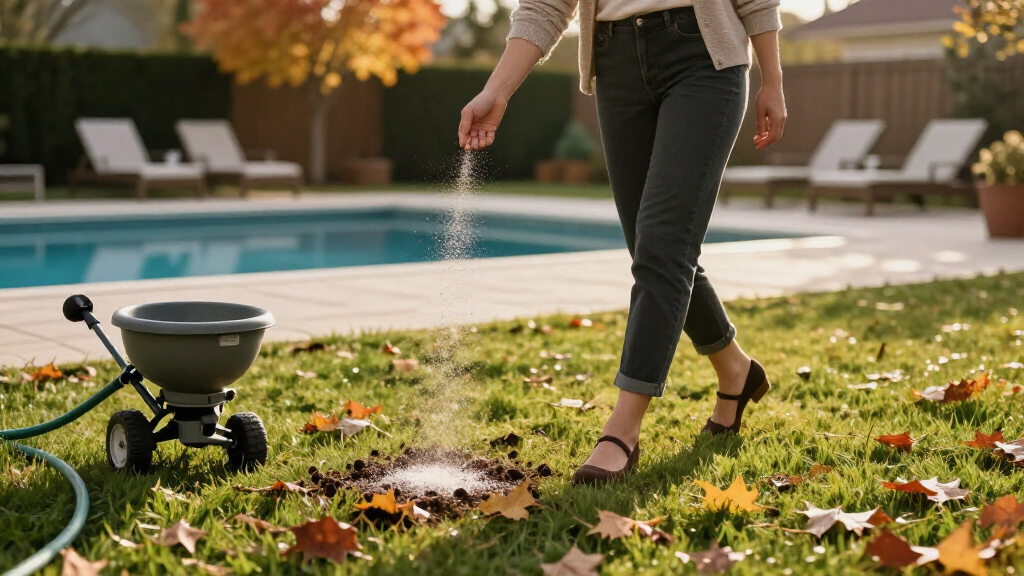
A Homes & Gardens report highlights watering as a key step when applying granular fertilizer to lawns in fall. Water helps move product off grass blades and into the soil, reducing the risk of fertilizer burn and helping nutrients reach roots. The report recommends using suitable rainfall or sprinklers, while following the product’s application directions.
Watering after fertilizing, rather than choosing a particular brand or formula, is the central advice in a Homes & Gardens report on fall lawn care. The report says water helps move granular feed from grass blades into the soil, where nutrients can reach roots, and reduces the risk of scorched patches.
The report explains that lawns may be recovering from summer heat and dry conditions as fall arrives. It says grass shifts relatively more energy toward root development as top growth slows, and that autumn feeding can support the turf as it prepares for winter. Those are general lawn-care claims in the report, not a guarantee that every lawn will recover or perform the same way.
Granular fertilizer needs to be watered off the grass blades and into the soil, according to Chris McIlroy, technical product lead and in-house lawn seed expert at The Grass People. The report warns that dry granules left on blades can dehydrate plant tissue and cause yellowing, browning or dead patches. It says synthetic granular products may begin causing damage within 24 to 48 hours if they are not watered in; the timing may vary by product and conditions.
Water also helps activate nutrients and carry them toward the root zone, the report says. It recommends applying fertilizer at the product’s stated rate, then watering with rain or a sprinkler. If relying on rainfall, McIlroy advises watching the forecast; the report suggests aiming for about one inch of rain and applying fertilizer roughly a day beforehand. If rain is not expected, it says sprinklers may be run for 30 to 60 minutes, with a tuna can used to measure how much water is reaching the lawn.
Watering Protects Grass and Feed
The advice matters because applying fertilizer without enough water may leave concentrated granules on the blades rather than moving them into the soil. That can mean less effective feeding and, according to the report, a risk of visible lawn damage. Homeowners can avoid wasting product by planning how to water before spreading it.
The report also links fall feeding to the lawn’s preparation for winter and growth in spring. Theresa Smith, senior vice president of NaturaLawn of America, says lawns fertilized in fall may green up sooner because of leftover carbohydrates. That is an attributed expert claim, not a promise that fertilizing will produce the same spring results for every yard.
For readers, the practical takeaway is to treat water and application rate as part of the fertilizing job, not as optional follow-up. Rain may supply the moisture, but local forecasts and actual rainfall can differ; a sprinkler and a simple collection test can help homeowners judge coverage.
Products Worth Considering

Husqvarna Automower 550 Commercial Robotic Lawn Mower

Rachio 3 Smart Bundle: 16 Zone Smart Sprinkler Controller & Weatherproof Outdoor Enclosure

EGO POWER+ 21 Cordless Electric Lawn Mower Kit, Self-Propelled
As an affiliate, we earn on qualifying purchases.
Fall Feeding After Summer Stress
The Homes & Gardens article frames autumn fertilizing as a way to help lawns recover after summer and prepare for colder conditions, including frost, ice and snow. It notes that fall lawn care may also include scarifying to remove thatch and aerating to improve the movement of water and nutrients through compacted soil.
Those steps are presented as helpful, not mandatory prerequisites. The report says a lawn can be fertilized without aerating first, although compacted soil may make it harder for moisture and nutrients to reach roots. Its main focus is still the watering step: applying a product correctly and getting it into the soil.
“To prevent grass blade burn or scorching after applying any lawn feed, it is really important to water off granular fertilizer from the grass blades to avoid damaging the existing grass.”
— Chris McIlroy, technical product lead and in-house lawn seed expert at The Grass People
Results Depend on Lawn Conditions
The report does not identify a single fertilizer product that is right for every lawn, nor does it give a universal application rate. Homeowners should follow the instructions on their chosen product and account for local soil, weather and lawn conditions. Its 24-to-48-hour warning concerns synthetic granular feeds and should not be treated as a precise deadline for every formulation.
It is also unclear how much fall feeding alone affects spring green-up across different lawns. Smith’s statement is attributed expert guidance; the report provides no comparative trial data or quantified results. Rain forecasts are uncertain as well, so homeowners relying on rainfall may need to check whether the lawn received enough water and supplement with a sprinkler if necessary.
Plan Water Before Applying Feed
Before applying fertilizer, homeowners can check the product label, inspect the lawn and review the local forecast. If a suitable rain is expected, the report advises timing application ahead of it; if not, sprinklers can provide water. A tuna can or similar straight-sided container can help measure sprinkler output, since delivery varies by system.
The next step is to monitor the lawn after application and avoid leaving granular product on blades. The report does not offer a follow-up timetable for every lawn, so any additional feeding or repair should be guided by product directions and the condition of the grass.
Key Questions
Why should fall lawn fertilizer be watered in?
According to the Homes & Gardens report, water moves granular fertilizer off the grass blades and into the soil, helping nutrients reach roots and reducing the risk of blade burn or scorching.
Can rain water in lawn fertilizer?
Yes. The report says rainfall can do the job if enough is expected. It suggests watching the forecast for about one inch of rain, while recognizing that actual conditions may differ and sprinklers may be needed as a top-up.
How long should I run a sprinkler after fertilizing?
The report gives a general range of 30 to 60 minutes when no wet weather is forecast. Sprinkler output varies, so it recommends measuring collected water with a tuna can rather than assuming every system delivers the same amount.
Is aeration required before fall fertilizing?
No. The report says fertilizing without prior aeration is possible, but compacted soil can reduce how effectively water and nutrients reach the roots. Aeration may help, but the article does not describe it as mandatory.
Source: rss