TL;DR
Floating waterproof speakers are portable Bluetooth speakers designed to stay afloat while playing audio, making them handy around pools, lakes, and boats. Check the product’s IP rating, float stability, battery estimates, and care instructions for your intended water and setting; no rating guarantees protection from every real-world exposure.
A speaker can survive a splash and still sink the moment it slips from your hand. Floating waterproof speakers address both problems: they are portable Bluetooth speakers designed to play audio while staying on the water’s surface. That can make a poolside playlist easier to hear without balancing a speaker on a wet ledge.

Get pool and patio gear delivered free with Prime
- Fast, free delivery on millions of items
- Prime Video, Amazon Music and more included
- Member-only deals all year
This guide explains what they are, what water ratings mean, and which details matter when you compare models. You’ll also get practical advice for pools, lakes, and showers, plus a care routine that helps you avoid turning a fun afternoon into a search for a lost speaker—or a damaged charging port.
An IPX7 rating covers a defined temporary fresh-water immersion test, not every pool, lake, or ocean condition.
Check float stability, visibility, and retrieval alongside the water rating.
Treat advertised battery life as an estimate; high volume and extra features can reduce playback time.
Confirm that a second speaker is compatible before buying it for stereo pairing.
Follow the manual for rinsing, drying, storage, and charging after water exposure.
What a floating speaker does when it hits the water
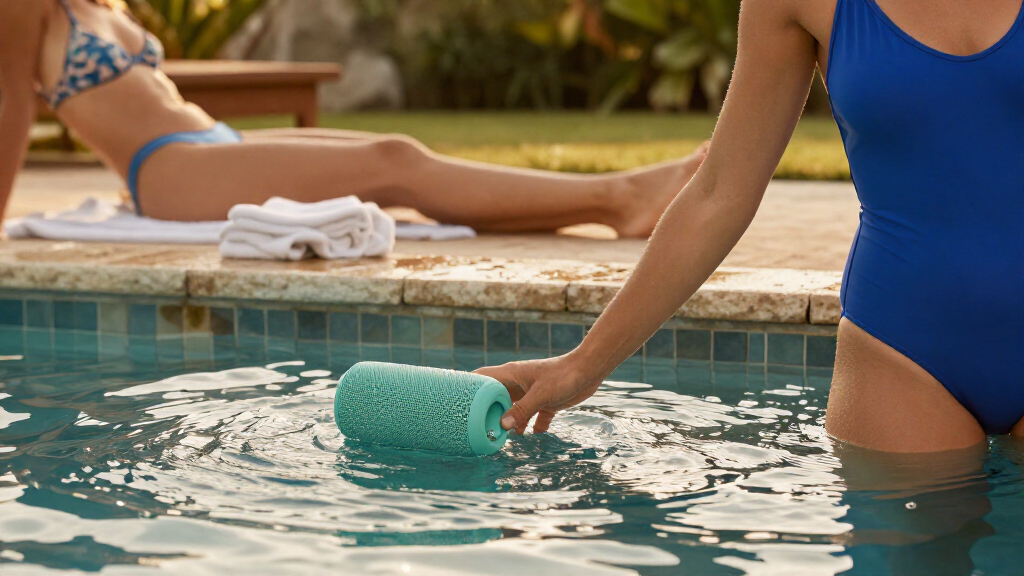
A floating waterproof speaker is a portable Bluetooth speaker with a buoyant housing that lets it remain on the water while it plays. Most connect to your phone or tablet wirelessly; some also support pairing with another speaker, app controls, or a built-in voice assistant. The floating shape is the difference you notice when a speaker slips off a pool float: it stays near the surface instead of disappearing below it.
That buoyancy is useful, but it doesn’t make a speaker impossible to lose. A breeze can push it across a pool, and lake currents can carry it farther than you expect. Imagine setting one beside you on a dock while you swim: a bright color and a stable, easy-to-grab shape may matter more than a clever app feature.
“Waterproof” also has limits. An IP rating describes protection under specific test conditions, not every kind of wet use. IPX7 generally covers temporary immersion in up to 1 meter of fresh water for up to 30 minutes in a controlled test; the X means the rating does not specify dust protection. It does not certify resistance to repeated immersion, high-pressure spray, pool chemicals, or salt water.
So read the manual as well as the product listing. If you want a speaker for a pool, check whether the maker permits that use and explains how to clean it afterward. One reassuring label cannot tell you how the product handles a whole summer of sun, splashes, and chlorine.
Products Worth Considering

Blackstone 2363 20 x 14-Inch Camping Griddle

Solo Stove Pi Prime Portable Propane Pizza Oven

Greenworks 80V Cordless Axial Leaf Blower Kit with 4Ah Battery and Charger
As an affiliate, we earn on qualifying purchases.
How to choose one that suits your pool, lake, or boat
Choose a floating speaker by matching its water protection, float behavior, and battery to where you’ll use it. For a calm backyard pool, easy retrieval and a clear care guide may be enough; for a boat, a secure strap and a shape that stays upright in small waves can matter more. Compare the details against your actual plans, not a generic “outdoor” label.
- Check the rating and instructions. Confirm whether the speaker is rated for immersion or splash exposure, and look for guidance about chlorine, salt water, and charging.
- Consider how it floats. Look for notes or demonstrations about stability and retrieval. A broad, bright speaker is easier to spot than a dark one bobbing beside a shadowy dock.
- Match battery claims to your outing. Treat advertised playback time as an estimate. High volume, cold weather, lights, and other features can shorten it.
- Check connection and sound. Bluetooth range varies with obstacles and interference. Outdoor spaces have fewer reflecting surfaces, so sound can feel thinner than it does in a living room.
- Choose useful extras. Stereo pairing, app EQ, USB-C charging, a strap, or a detachable design may help, but confirm model compatibility before you buy.
For example, if you’re hosting a four-hour pool gathering, a maker’s maximum battery estimate may leave little margin if you play music loudly with the lights on. A model with a realistic runtime estimate and simple controls can serve you better than one with a long feature list. Bluetooth version alone does not determine sound quality or range.
What IPX7 and IP67 tell you—and what they leave out
IPX7 means tested temporary immersion under specified conditions; it is not a promise that a speaker can live in a pool. IP67 includes a dust-protection rating as well as the same water-level digit, while the X in IPX7 means no dust rating is specified. The numbers help you compare products, but they describe test results rather than every detail of everyday use.
That distinction matters because a pool is not a test tank. Chlorinated water, sunlight, repeated wet-and-dry cycles, and a charging port that never fully dries can all change the risks. A lake adds wind and currents. At the ocean, salt residue can be corrosive, and waves can turn an easy-to-retrieve speaker into a moving target.
Picture a family picnic at the beach: a speaker may float perfectly in still water, then drift away when the wind picks up. The rating will not tell you how fast it moves or whether you can spot it against the waves. A bright finish, wrist strap, and close supervision can make a practical difference.
Follow the maker’s stated use and care instructions for the exact model. Some products may call for a fresh-water rinse after exposure to salt or chlorine, followed by thorough drying. Keep the charging port and cable dry before charging. If you plan to use a speaker in the shower, check the instructions first: spray and soap exposure may differ from the immersion test conditions.
How to get better sound and a steadier connection outdoors
Outdoor sound often seems less full because open spaces provide fewer surfaces to reflect it back to you. Placement, volume, and distance can matter as much as the speaker’s advertised power. A speaker that sounds rich on a kitchen counter may feel quieter in the middle of a bright, echo-free pool area.
Try placing the speaker where you can hear it without turning the volume all the way up. For instance, at a small backyard gathering, setting it near the group on a stable, dry ledge can sound clearer than leaving it far out in the water. Keep it within the maker’s recommended Bluetooth range, and remember that bodies, walls, and other wireless devices can affect the connection.
Features can help, but check the specifics. Some models offer app-based equalizer controls, lighting, or pairing with another speaker. If you want stereo sound, confirm that both speakers belong to a compatible model family; two Bluetooth speakers do not automatically pair for stereo playback. USB-C charging and newer Bluetooth versions are increasingly common, but neither guarantees a particular runtime or sound quality.
A practical example: if you’re listening from a patio while the speaker floats at the far end of a pool, a connection that works across an empty room may falter when people move between your phone and the speaker. Keep the phone closer, test the arrangement before guests arrive, and turn the volume up only as much as the setting needs.
How to use and care for your speaker after a swim
Good care starts before the first splash: read the manual, keep charging parts dry, and plan how you’ll retrieve the speaker. A water rating does not automatically cover charging while wet, continuous exposure, or unattended time in a pool. If children are swimming, keep an adult actively supervising them and keep the speaker from distracting anyone responsible for watching the water.
After using the speaker in a pool or at the coast, follow the model’s care instructions. If the manufacturer recommends it, rinse away chlorine or salt with fresh water, then let the speaker dry fully before charging or storing it. A simple end-of-day routine—retrieve it, inspect the ports, rinse if allowed, and air-dry—can help prevent residue from building up.
Think of a family afternoon at the lake. Wind moves the speaker beyond arm’s reach, and a child reaches for it from the dock. A floating design can prevent a quick slip from becoming a lost-device problem, but it does not make the water safe or replace close adult supervision. Keep the speaker within easy reach and never ask a child to retrieve it from deep or moving water.
Store it away from direct sun and heat if the manual advises that, and check the housing for damage after a drop. Even a small crack or loose port cover can make the original water rating less meaningful. When you’re unsure whether a particular exposure is allowed, the product’s instructions are a better guide than the word “waterproof” on the box.
Frequently Asked Questions
Can I leave a floating speaker in the pool?
Only if the manufacturer’s instructions allow that use. A water rating may not cover continuous exposure, pool chemicals, direct sun, or leaving the speaker unattended. Retrieve it when you finish listening and follow the recommended care steps.
Will a floating speaker work in a lake or ocean?
Check the product description for floating use, then account for wind, waves, and currents that can carry it away. Salt water can leave corrosive residue, so follow the maker’s cleaning instructions after ocean use.
Can I charge the speaker while it is wet?
Keep charging ports and cables dry before charging unless the manufacturer explicitly says otherwise. Water near a charging connection can damage the device or create a safety concern. Check the manual for the model’s instructions.
How long will the battery last outdoors?
Use the manufacturer’s playback figure as an estimate, since test conditions may differ from your outing. High volume, cold temperatures, lighting, and other features can shorten listening time. If you’re planning a long day by the water, charge it fully first.
Is a floating speaker better than a regular waterproof speaker?
A floating model makes sense when you want the speaker to stay on the water’s surface and be easier to retrieve after a slip. For travel or general outdoor use, a non-floating waterproof speaker may have a more convenient shape or features. Compare the care instructions and water exposure limits either way.
Conclusion
Pick a floating speaker for the water you actually use, then check its rating, float design, sound, and care instructions before you buy. A careful choice can keep a playlist within earshot while your hands are busy with towels, snacks, or a paddle.
Keep it close, dry its charging parts, and give the water your full attention—especially when children are swimming. The best pool soundtrack is the one you can enjoy without taking your eyes off the people in the water.