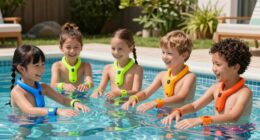

In the pool, HIIT involves short, intense bursts of effort against water resistance, followed by brief rests, helping you build strength and burn calories quickly. Steady-state keeps you moving at a moderate, consistent pace, focusing on endurance and longer workout sessions. Both use water’s natural resistance to challenge your muscles, but HIIT emphasizes rapid, high-effort movements, while steady-state promotes sustainability. To understand how to tailor these most effectively to your goals, discover more below.
Key Takeaways
- HIIT involves short, intense efforts with quick recovery, while steady-state maintains moderate effort over longer durations.
- Water resistance amplifies effort in both methods but HIIT maximizes muscle activation during high-intensity intervals.
- HIIT boosts strength and power rapidly, whereas steady-state enhances endurance and cardiovascular capacity.
- HIIT is suitable for quick fitness gains, while steady-state provides a sustainable, joint-friendly workout.
- Both leverage water’s resistance to improve calorie burn and muscular endurance, tailored to different fitness goals.
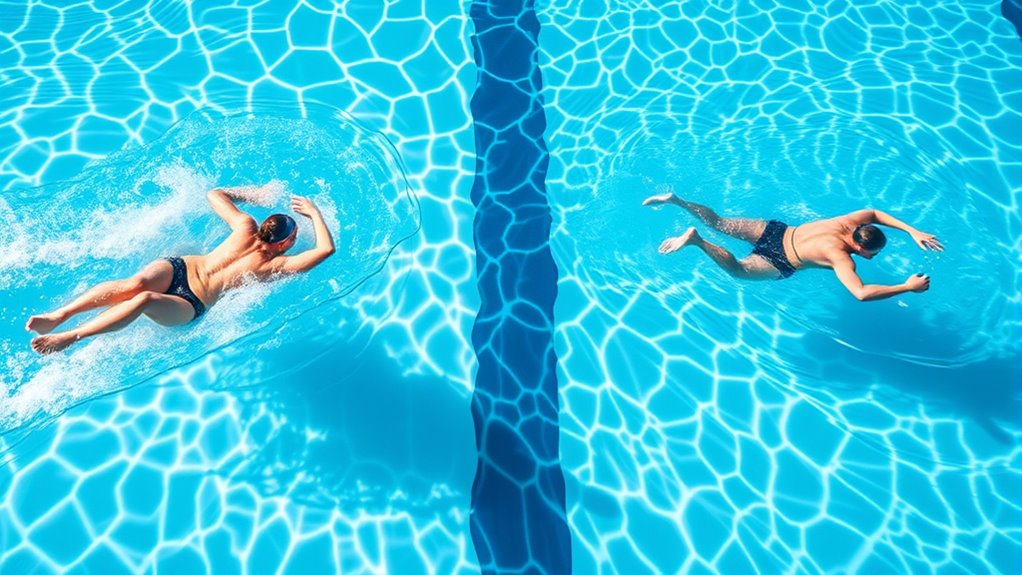
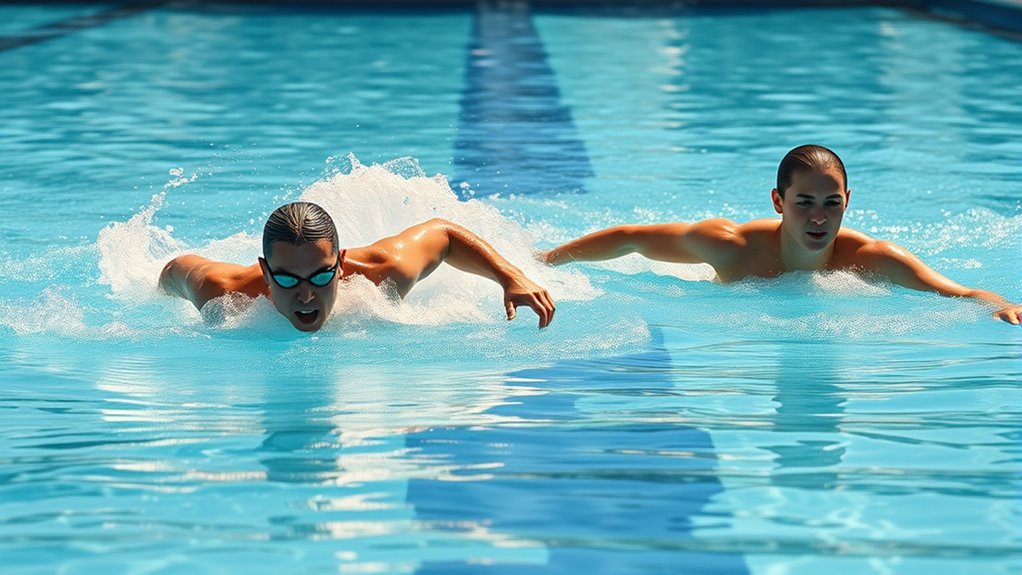
When it comes to aquatic exercise, choosing between High-Intensity Interval Training (HIIT) and steady-state workouts can profoundly impact your fitness goals. Both approaches leverage the unique environment of the pool, but they do so in different ways that influence your results. Understanding how water resistance and muscle engagement differ between these methods helps you make an informed choice that aligns with what you want to achieve.
Choosing between HIIT and steady-state water workouts impacts your fitness goals by leveraging water resistance differently.
In HIIT workouts, you push your body to its limits for short bursts, typically 20 to 30 seconds, followed by brief recovery periods. This pattern makes water resistance your best ally, as it naturally slows your movements and increases effort without additional equipment. The constant push against water’s resistance means your muscles stay engaged throughout the entire session, maximizing calorie burn and improving muscular endurance in a short period. Because of the intensity, HIIT in the pool demands focused effort, activating multiple muscle groups simultaneously to overcome water’s drag. This results in a more dynamic workout that not only boosts cardiovascular health but also promotes muscle strength and power. When you perform these high-intensity intervals, every movement—from sprints to jumps—is slowed down by water resistance, forcing your muscles to work harder and adapt quickly.
Steady-state workouts, on the other hand, involve maintaining a consistent, moderate effort over a longer duration, often 30 minutes or more. During these sessions, water resistance remains a constant challenge, but because your pace is steadier, the focus shifts towards sustained muscle engagement and cardiovascular endurance. You’ll find that your muscles stay active over time, gradually building stamina without the sharp spikes of effort seen in HIIT. Steady-state exercise allows you to develop a smooth, rhythmic movement pattern, which can be easier on joints and more sustainable for longer periods. As you maintain a steady pace, the muscles involved are continuously engaged, but the intensity tends to be lower than in HIIT, making this approach ideal for building aerobic capacity and promoting recovery.
Ultimately, the choice depends on your goals. If you’re aiming for rapid improvements in strength and explosive power, HIIT offers a more intense workout that capitalizes on water resistance and muscle engagement. If endurance, consistency, and joint-friendly exercise are your priorities, steady-state workouts provide a sustainable way to stay active while still benefiting from the resistance of water. Both methods harness the pool’s natural properties, but they do so in ways that suit different fitness strategies. Recognizing how water resistance continuously challenges your muscles in both formats helps you tailor your training to get the most out of your time in the pool.
pool HIIT workout equipment
As an affiliate, we earn on qualifying purchases.
As an affiliate, we earn on qualifying purchases.
Frequently Asked Questions
Which Method Burns More Calories per Session?
HIIT burns more calories per session than steady-state workouts because of its higher workout intensity. You’ll find that the calorie comparison favors HIIT, as it pushes your body harder and boosts your metabolic rate even after you finish. This makes HIIT more efficient for calorie burning within a shorter time, enhancing your overall workout efficiency. If you’re aiming for maximum calorie burn, incorporating HIIT in the pool is a smart choice.
How Does Water Temperature Affect Workout Intensity?
You’ll find that warmer water reduces water viscosity, making your movements easier and lowering workout intensity. Conversely, colder water increases viscosity, demanding more muscle engagement and boosting your workout’s difficulty. So, if you want a more intense session, opt for colder water. Warmer temperatures ease your effort, but may lessen the challenge. Adjusting water temperature directly influences how hard your muscles work and how vigorous your workout feels.
Can Beginners Safely Perform HIIT in the Pool?
Yes, beginners can safely perform HIIT in the pool when they focus on water resistance and injury prevention. Start slow with low-impact exercises, gradually increasing intensity as you build strength and confidence. Use proper technique, listen to your body, and take breaks when needed. The water’s resistance helps protect your joints, making HIIT a safe, effective way to boost fitness while minimizing injury risk.
How Long Should Each Session Last for Optimal Results?
For ideal results, aim for exercise durations of 20 to 30 minutes per session, including warm-up and cool-down. You should perform 3 to 4 sessions weekly, balancing intensity and recovery. If you’re just starting, consider shorter sessions and gradually increase as your fitness improves. Consistency is key, so stick to your schedule, and listen to your body to prevent overtraining or injury.
Does One Method Improve Swimming Speed More Effectively?
Surprisingly, steady-state training often boosts your swimming speed more effectively than HIIT, so don’t dismiss the long, steady laps. You’ll see better results with consistent training, which also helps prevent injuries by avoiding burnout. While HIIT is great for quick gains, steady pace builds endurance and technique, ultimately making you faster. Keep at it, stay consistent, and injury prevention becomes easier—your swimming speed will thank you.

Water Gear Resistance Bells – Water Fitness and Pool Exercise – Intense Workout Without Added Stress – Easy on Joints (YELLOW, 60% Resistance)
RECOVERY – These aquatic dumbbells are a great buy for someone who is currently rehabbing any upper body…
As an affiliate, we earn on qualifying purchases.
As an affiliate, we earn on qualifying purchases.
Conclusion
Whether you prefer the explosive fireworks of HIIT or the gentle tide of steady-state, both methods shape your swim journey. Think of HIIT as lightning flashing across the sky—powerful and exhilarating—while steady-state is like a calm, steady river carving its path. Whichever you choose, embrace it with passion. Plunge in and let your workout be the current that carries you toward stronger, fitter, and more confident you. Your pool, your rules—make every stroke count.
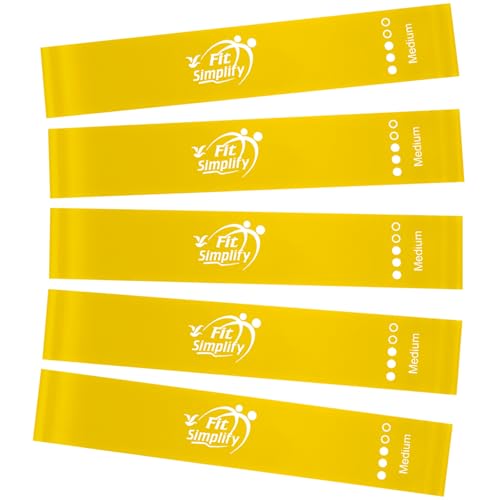
Fit Simplify Exercise Resistance Loop Bands, Set of 5
Medium Exercise Band Set: This set of 5 medium 12 inch by 2 inch resistance bands is ideal…
As an affiliate, we earn on qualifying purchases.
As an affiliate, we earn on qualifying purchases.
swimming pool workout accessories
As an affiliate, we earn on qualifying purchases.
As an affiliate, we earn on qualifying purchases.