

Get pool and patio gear delivered free with Prime
- Fast, free delivery on millions of items
- Prime Video, Amazon Music and more included
- Member-only deals all year
Inflatable Haunted House vs. Built Haunted House: Which One Deserves Your October?
Every Halloween, the same fork appears for homeowners, HOA event planners, and small haunt operators: do you buy an inflatable haunted house — the self-inflating, blow-up walkthrough or facade sold by brands like Gemmy, Home Accents Holiday, and B-Zeer — or do you build a static haunt from PVC, plywood, tarps, and store-bought props? These two options get compared because they sit at opposite ends of the same decision: how much scare do you get per dollar and per hour of your labor.

Kalolary 12FT Halloween Inflatable Haunted House Archway
- ✔ Height: 12 ft
- ✔ Material: 210T polyester fiber
- ✔ Lighting: Built-in LED lights

Halloween Inflatable Haunted House Maze with Removable Roof and Blower (20x20ft)
- ✔ Dimensions: 20 x 20 x 6.56 ft (6 x 6 x 2 m)
- ✔ Material: 420D Oxford cloth fabric
- ✔ Roof: Removable

Giant Inflatable Haunted House Outdoor Maze Game for Halloween (26ft x 26ft, with Blower)
- ✔ Dimensions: 26 x 26 x 6.6 ft (8 x 8 x 2 m)
- ✔ Material: Commercial-grade 420D Oxford fabric
- ✔ Detailing: Fully spray-painted graphics
The core difference is simple. An inflatable haunted house is a fabric structure that a continuous blower keeps upright; most inflate in under five minutes and fold into a storage bag. A traditional built haunt is a walk-through or facade you assemble from framing, panels, scene dressing, and lighting — it costs more, takes longer to set up, but delivers a denser, more convincing atmosphere and survives contact with weather and rowdy trick-or-treaters far better. The inflatable wins on convenience, price, and storage; the built haunt wins on scare quality, structural resilience, and year-over-year expandability.
If you want a big visual statement with near-zero effort and a sub-$500 budget, the inflatable is likely your answer. If you want trick-or-treaters to actually hesitate before entering, or you’re running a repeat event, the built haunt earns its extra cost. Below we compare both across the criteria that actually drive this decision so you can match the option to your yard, your budget, and your tolerance for October weekends spent with a staple gun.
Kalolary 12FT Halloween Inflatable Haunted House Archway
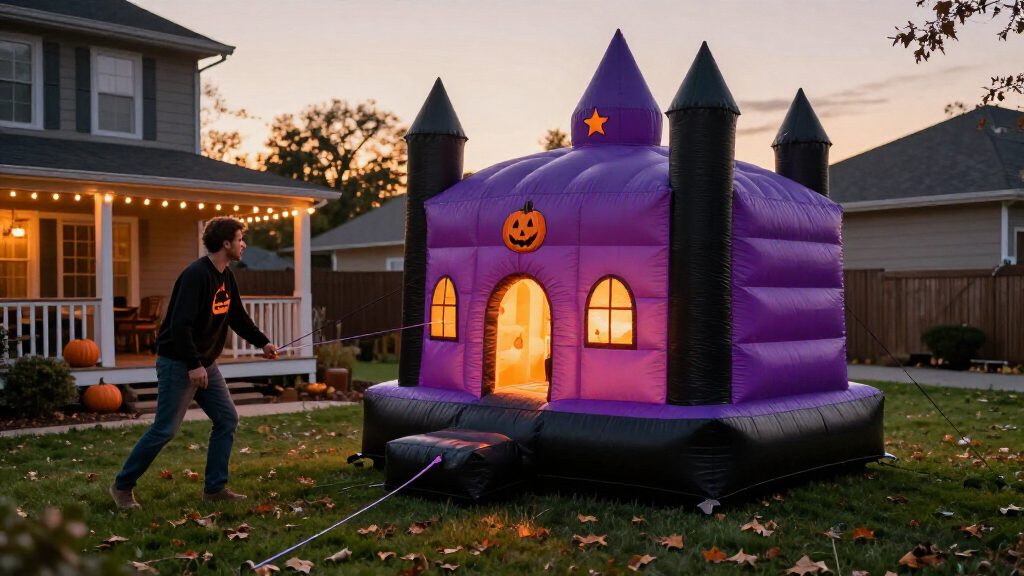
The Kalolary 12FT archway earns our top spot because it solves the problem most inflatable haunted houses create: it delivers the full haunted-house effect at a scale that fits an ordinary suburban lawn. Standing 12 feet tall with a stereoscopic house design, it reads as an impressive nighttime display from the street while still functioning as a walk-through tunnel that kids can actually enter — a step beyond the flat, look-only inflatables that dominate the category.Compared with the two mazes below, the Kalolary makes deliberate tradeoffs in fabric and scale. Its 210T polyester is lighter than the 420D Oxford cloth on the maze models, which keeps the price and bulk manageable but makes it less suited to repeated commercial use. Kalolary partially offsets this with an upgraded blower rated for slightly humid conditions and a built-in sandbag at the base, so it holds up better than typical lightweight inflatables in damp autumn air. Setup is a genuine strong point: stakes, metal buckles, tethers, and blower are all included, and self-inflation takes only a few minutes.The honest limitation is capacity. Where the 20x20ft maze can host a party’s worth of kids, the Kalolary handles a few people at a time — fine for trick-or-treaters passing through, not for an organized event. It also cannot run in heavy wind or rain, and it needs a standard outlet within cord reach.
Pros:
- 12-foot stereoscopic design works as both street-facing decoration and walk-through play tunnel
- Built-in bright LED lights create a strong nighttime display
- Complete installation kit included with quick self-inflating setup
- Upgraded blower and built-in sandbag improve stability in slightly humid conditions
Cons:
- Not recommended for heavy wind or rain
- Lighter 210T fabric is less durable than the maze models’ 420D Oxford cloth
- Requires a large open outdoor space relative to typical lawn inflatables
Best for: Homeowners who want a dramatic, LED-lit walk-through display on a normal-sized front yard
Not ideal for: Event organizers or rental operators who need to move large groups through at once
Bottom line: The best balance of impact, footprint, and price for residential Halloween decorating, provided you do not need event-scale capacity.
“The best balance of impact, footprint, and price for residential Halloween decorating, provided you do not need event-scale capacity.”
Halloween Inflatable Haunted House Maze with Removable Roof and Blower (20x20ft)
Once your plans shift from decorating to hosting, the 20x20ft maze is where the category starts making sense. This is a true walk-through attraction with interior corridors, built from 420D Oxford cloth — noticeably heavier and more abuse-tolerant than the Kalolary’s 210T polyester, and the right fabric class for anything that will see crowds of kids running through it.Its smartest design decision is the removable roof, which is more practical than it sounds. With the roof off, parents and supervisors can see directly into the maze, which matters enormously for younger children or party settings where adults want line of sight — something the fully enclosed 26x26ft model cannot offer. Compared with that larger maze, this one is easier to store, easier to transport, and less demanding on your yard, while still comfortably handling a Halloween party’s worth of guests.The kit is genuinely complete: blower, LED light, storage bag, sandbags, ground nails, rope, and even repair materials, which signals the manufacturer expects real repeated use. The tradeoffs are shared across all mazes — it cannot run in heavy rain, must be kept clear of sharp objects, and all zips must be closed before inflating or the structure will not hold pressure. It also consumes a 20x20ft patch of flat ground, which rules out most standard backyards.
Pros:
- True walk-through maze layout sized for parties and light rental use
- Durable, reusable 420D Oxford cloth construction
- Removable roof allows adult supervision inside the maze
- Complete accessory kit including blower, LED light, sandbags, and repair materials
Cons:
- Requires a large, flat 20x20ft open area
- Cannot be used in heavy rain and must stay clear of sharp objects
- All zips must be verified closed before inflation
Best for: Party hosts and small-scale rental operators who want a real walk-through maze with supervision-friendly design
Not ideal for: Homeowners with limited yard space or anyone wanting a simple set-and-forget decoration
Bottom line: The most sensible maze for first-time event hosts, offering commercial-grade fabric and a supervision-friendly roof at a more manageable footprint than the 26-footer.
“The most sensible maze for first-time event hosts, offering commercial-grade fabric and a supervision-friendly roof at a more manageable footprint than the 26-footer.”
Giant Inflatable Haunted House Outdoor Maze Game for Halloween (26ft x 26ft, with Blower)
The Giant 26x26ft maze is the ceiling of this category — a full-scale attraction built for events where throughput and visual impact are the whole point. Its footprint is nearly double the 20x20ft model, and that size buys longer corridors, more simultaneous visitors, and a presence that photographs like a professional haunted attraction rather than a party accessory.What separates it from the 20x20ft maze is not just dimensions but finish: the fully spray-painted detailing on commercial-grade 420D Oxford fabric gives the walls and exterior a hand-painted density of detail that printed graphics cannot match, which matters when the unit is the centerpiece of a festival or ticketed event. The included high-power blower inflates the structure in minutes despite its size, and the accessory package — storage bag, sandbags, ropes, stakes, repair materials — reflects genuine commercial expectations.The drawbacks are simply the flip side of its strengths. It demands an enormous flat site, meaningful setup labor, and a power arrangement that can run a high-power blower continuously. Like its smaller sibling, it cannot operate in heavy rain, must be kept away from sharp objects, and requires every zipper closed before inflation. For a homeowner, it is outright overkill; for a rental operator or event planner, it is the pick that justifies its premium positioning.
Pros:
- Largest footprint in the lineup, handling event-level visitor throughput
- Commercial-grade 420D Oxford fabric with fully spray-painted detailing
- High-power blower inflates the giant structure in minutes
- Full accessory kit including storage bag, sandbags, ropes, stakes, and repair materials
Cons:
- Requires an extremely large, flat, open venue
- Higher cost and setup effort than both smaller options
- No removable roof option, limiting direct supervision inside compared with the 20x20ft maze
Best for: Rental businesses, festivals, and large-ticket Halloween events that need maximum capacity and visual impact
Not ideal for: Residential users and anyone without a large flat venue and help with setup
Bottom line: The premium event-grade choice — buy it only if you genuinely need 26 feet of maze, because everything about it assumes commercial-scale use.
“The premium event-grade choice — buy it only if you genuinely need 26 feet of maze, because everything about it assumes commercial-scale use.”
As an Amazon Associate we earn from qualifying purchases.
At a Glance
| Criteria | Inflatable Haunted House | Traditional Built (Static) Haunted House | Winner |
|---|---|---|---|
| Upfront Cost | $100–$800 depending on size; large walk-through models near the top of that range | $300–$3,000+ depending on size and prop density | A |
| Setup Time & Effort | 5–15 minutes with one person: unroll, stake, plug in blower | Several hours to multiple days; usually needs two people and tools | A |
| Scare Factor & Atmosphere | Moderate — fun and cartoonish on most models; walk-through versions add motion and sound | High — controlled sightlines, blacklight, fog, jump scares, and actor hides | B |
| Durability & Weather Resistance | Fabric tears in wind above ~20–25 mph; must be deflated in storms | Withstands wind and rain with proper anchoring; can run in light weather all season | B |
| Storage Footprint | Folds into a duffel-sized bag; very compact off-season | Panels and props fill a garage corner or shed; lumber may not break down | A |
| Safety & Supervision Needs | Constant blower noise; needs supervision during use; anchor points must be secure | No live blower; sturdier walls; fewer tip-over risks if built well | B |
| Expansion & Reuse | Fixed design; add-ons limited to external props | Modular — extend, re-theme, and improve every year | B |
| Overall Visual Impact at Night | Bright, glowing, visible from the street — reads as a beacon | Darker and moodier; impact depends on your lighting skill | Depends |
Key Differences
The first real difference is the ratio of effort to payoff. An inflatable haunted house converts one extension cord and five minutes into a nine-to-twelve-foot structure that looks impressive from the curb. That speed is its superpower and its ceiling: because it’s one sewn piece of polyester, the interior is whatever the factory printed. Most walk-through inflatables rely on a few printed ghouls, a motion sensor, and a speaker — charming, but a savvy 10-year-old stops being scared within seconds. A built haunt controls what visitors see, when they see it, and from which angle, and that control is what actually produces fear. If your goal is a photo backdrop and a fun tunnel for kids, the inflatable’s ceiling is irrelevant. If your goal is screams, it is the whole ballgame.
The second difference is resilience. Inflatables live and die by the weather: a windy Halloween night means someone has to go outside, unplug, and deflate, and a torn seam or a cheap zipper can end the display entirely. Built haunts anchored properly shrug off gusts and drizzle and can stay up for weeks without attention. The tradeoff is that the built haunt’s durability is paid for in labor up front and in garage space all year — panels don’t fold into a duffel bag.
Third is trajectory over time. The inflatable is a finished product on day one and a finished product in year five — nothing to improve, nothing to add except external props. The built haunt is an investment that compounds: this year’s two-panel facade becomes next year’s four-room maze. For a household or event that repeats annually, the built option usually becomes the better value in year two or three, while the inflatable’s value is front-loaded into its first, easiest Halloween.
Detailed Comparison
Upfront Cost (Inflatable Haunted House wins — major)
Inflatable haunted houses run roughly $100 for small facade models to $500–$800 for large walk-through versions from major seasonal brands. A comparable built haunt — framing, black poly walls, lighting, fog machine, and a modest prop budget — realistically starts at $300–$500 and climbs quickly past $1,000 as scene density grows. The inflatable wins on cost, and the gap is major for first-time buyers: you can be fully operational for the price of a single good animatronic. The practical consequence is that the inflatable opens the category to people who would never justify haunt-building as a hobby, while the built route is a commitment.
Setup Time & Effort (Inflatable Haunted House wins — major)
This is the inflatable’s strongest category and it isn’t close. Unroll, stake four anchor points, plug in the blower, and the structure stands in three to five minutes; teardown is equally fast. A built haunt of similar visual weight takes a full weekend for a basic facade and multiple weekends for a walk-through, plus two people for panel raising. The gap is major. In practice, this means the inflatable suits people with limited free time, physical limitations, or yards shared with sports equipment and dogs, while the built haunt demands planning that starts in summer.
Scare Factor & Atmosphere (Traditional Built (Static) Haunted House wins — major)
Most inflatable haunted houses, even walk-through models, land closer to ‘fun spooky’ than ‘scary.’ The interior is printed graphics, a few dangling figures, and a motion-activated sound module; the constant fan noise also undercuts any audio atmosphere. A built haunt lets you control darkness, sightlines, timing, fog density, and jump-scare placement — the mechanics of actual fear. Adults and older kids will remember a good built haunt; they will take one photo in front of the inflatable. This gap is major if your audience is over roughly eight years old, and minor if your audience is younger kids who mostly want a safe, silly tunnel.
Durability & Weather Resistance (Traditional Built (Static) Haunted House wins — major)
Inflatables are vulnerable: sustained wind above roughly 20–25 mph risks tipping or tearing, seams and zippers are common failure points, and responsible use means deflating before storms — sometimes mid-party. Built haunts with proper anchoring handle wind and light rain and can stand for the whole season. The gap is major for anyone in a windy region or anyone who wants a set-and-forget October display. Note that neither option handles determined vandalism well, but a torn tarp is cheaper to replace than a shredded inflatable.
Storage Footprint (Inflatable Haunted House wins — major)
The inflatable collapses into a bag roughly the size of a large duffel or two; it slides onto a shelf for eleven months. Built haunt panels, lumber, and props consume a garage corner, a shed, or a basement section year-round. The gap is major for anyone with limited storage. In practice, this single factor eliminates the built option for apartment dwellers and small-home owners regardless of their enthusiasm.
Safety & Supervision Needs (Traditional Built (Static) Haunted House wins — moderate)
The inflatable needs stakes checked, a supervised blower and cord, and quick deflation capability; a walk-through full of children plus an inflating fan means an adult should be present. A well-built haunt has heavier walls, no live inflation, and no sudden-collapse mode, though its dark interiors and trip hazards require their own basic management. The built haunt wins moderately — its failure modes are slower and more predictable. For events with unsupervised foot traffic, either way you need a perimeter plan.
Expansion & Reuse (Traditional Built (Static) Haunted House wins — major)
An inflatable is a closed system: what you bought is what you have, and re-theming means buying a different inflatable. A built haunt is modular — add a corridor, a new scene, better lights, or an actor hide each year. For repeat Halloween hosts, school carnivals, and neighborhood events, the built haunt compounds in value while the inflatable plateaus immediately. Gap: major for repeat users, minor for one-off buyers.
Nighttime Visual Impact (Curb Appeal) (moderate difference)
Here it depends on your goal. The inflatable glows from internal lighting and reads instantly from the street — excellent for attracting trick-or-treaters and photos. The built haunt can be made equally striking with uplighting and silhouette techniques, but its impact depends on your lighting skill, and a mediocre build can look like construction tarps. For pure curb appeal per hour of effort, the inflatable wins; for immersive impact once someone approaches, the built haunt wins. Call it a genuine tie with different strengths.
Inflatable Haunted House: Pros and Cons
Pros:
- Sets up and tears down in minutes with one person
- Lowest cost entry into large-scale Halloween decor
- Folds into a compact bag for off-season storage
- Bright, internally lit, and highly visible from the street
- Kid-friendly tone works well for family audiences and school events
Cons:
- Scare factor is limited — reads as fun rather than frightening
- Constant blower noise kills audio atmosphere
- Vulnerable to wind, tears, and zipper/seam failures; must be deflated in storms
- No meaningful way to expand or re-theme beyond external props
- Feels like a product, not a scene — savvy visitors lose interest fast
Traditional Built (Static) Haunted House: Pros and Cons
Pros:
- Genuine scare potential through controlled darkness, fog, and timing
- Withstands wind and weather; can stay up all season
- Modular and expandable — improves every year
- No dependence on a running blower; sturdier structure around visitors
- Becomes a tradition and a canvas for creativity and actors
Cons:
- Far more upfront cost and multi-day build labor
- Usually needs two people and basic tools for assembly
- Consumes significant storage space year-round
- A mediocre build can look cheap without lighting and dressing effort
- Requires seasonal planning that starts months before October
Who Should Choose What
Choose Inflatable Haunted House if:
- You want a big Halloween statement with under $800 total spend and zero construction
- Your audience is mostly younger kids or families who want fun-spooky, not frightening
- You have limited storage, a small yard crew (just you), or limited October free time
- You’re decorating for a one-off event, trunk-or-treat, or a school function
- You live somewhere with calm Halloween weather or don’t mind deflating on windy nights
Choose Traditional Built (Static) Haunted House if:
- Your audience includes tweens, teens, or adults you actually want to scare
- You host annually and want a display that grows and improves each year
- You have a garage or shed for storing panels and props off-season
- You enjoy building as much as the event itself — or you run a paid or fundraiser haunt
- Your area gets wind or rain and you need something that stays up through it
Skip both if: You have no yard or storage at all — indoor doorway scenes, window projections, or a strong lighting package on your house delivers more atmosphere per dollar than either large structure.
Value for Money
The inflatable is the better value for exactly one profile: the first-time or occasional decorator. It delivers maximum visual return per dollar and per hour in year one, and nothing after that. If you buy a large walk-through inflatable at $600 and use it for four Halloweens, the cost-per-season is excellent even if the experience never deepens.
The built haunt is the better value for repeaters. A $600 built facade looks thinner than a $600 inflatable in year one, but by year three you’ve added scenes and lighting, and the same materials are still in service while the inflatable owner is shopping for a different product to fight boredom. If your household treats Halloween as an annual project, the built haunt’s higher upfront cost amortizes into clearly superior returns; if it doesn’t, that extra money buys lumber that gathers dust.
Is paying more for a premium inflatable — the big walk-through models at $500–$800 — worth it over a standard one? Only if you’ll actually run it as a walk-through with kids passing through regularly. As a static facade, a $200–$300 model delivers nearly the same curb appeal, and the premium buys interior features most passersby never see.
Final Verdict
Choose the inflatable haunted house if your priority is a fast, affordable, family-friendly centerpiece — it is the right call for most casual decorators, parents of younger kids, and one-off event hosts, and no other option matches its effort-to-impact ratio. Choose the built haunt if scaring people is the actual goal, if you decorate every year, and if you have the storage and the weekends — it is the only option that produces real fear and compounds in value over time.
The single deciding factor is your audience’s age and your repeat intent. Young kids plus low effort plus one or two Halloweens: buy the inflatable, and buy the mid-range model, not the premium one. Tweens, teens, or adults plus an annual tradition: build, even if you start with just two panels and a fog machine this year. For the majority of first-time buyers reading this comparison, the inflatable is the smarter first purchase — and if the Halloween bug bites, it makes a fine facade in front of the haunt you build next.
Frequently Asked Questions
Can people actually walk through an inflatable haunted house?
Some models are true walk-throughs with entrances, exits, and interior props, while others are facades or bounce-house-style play structures. Check the listing carefully: ‘haunted house inflatable’ covers both. Walk-through versions are designed for kids to pass through in under a minute — they’re an experience, not a maze.
Will an inflatable haunted house survive wind and rain?
Light rain is usually fine; wind is the real threat. Most manufacturers rate their inflatables for roughly 20–25 mph sustained wind before you should deflate and secure them. Staking all anchor points properly matters far more than the included stakes sometimes allow — upgrading to longer stakes or sandbags is a cheap reliability win.
How much does a decent built haunted house cost to make?
A basic facade — PVC or lumber frame, black poly walls, lighting, and a fog machine — runs $300–$500 in materials. A small walk-through with multiple scenes typically lands between $800 and $2,000 depending on prop density. Costs drop in later years since structure is reusable and only props and dressing get replaced.
Are inflatable haunted houses too scary for young children?
Almost never. Most lean cartoon-spooky with smiling skeletons and friendly ghosts, and the loud fan noise tends to dilute atmosphere rather than build it. If anything, parents report the opposite problem: kids find them fun rather than frightening, which is exactly right for the under-eight crowd and exactly wrong for teens.
Can I combine both approaches?
Yes, and it’s a strong play. A large inflatable works well as a glowing beacon and photo-op at the curb, drawing people toward a darker, built walk-through behind or beside it. The inflatable handles the marketing; the build handles the scares.
Halloween Picks
halloween
As an affiliate, we earn on qualifying purchases.