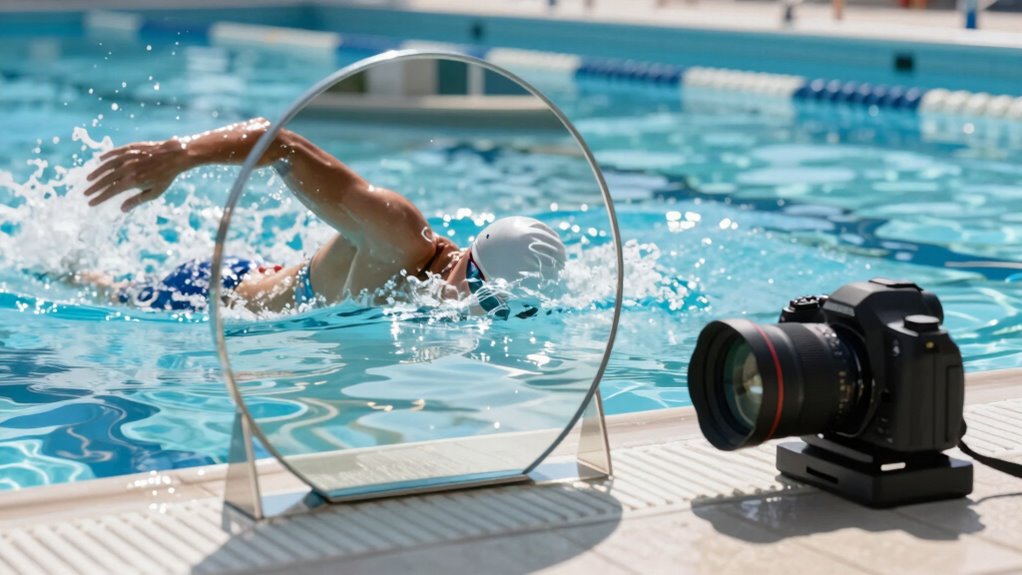

Swim mirrors and cameras give you instant, visual feedback that helps you spot and fix form issues quickly. They allow you to see your stroke mechanics from different angles, making it easier to identify problems like arm entry or body alignment. Clear underwater views and real-time analysis boost your understanding and confidence. When you optimize visibility, your technique improves faster. Keep exploring to discover even more ways these tools can transform your swimming progress.

Get pool and patio gear delivered free with Prime
- Fast, free delivery on millions of items
- Prime Video, Amazon Music and more included
- Member-only deals all year
Key Takeaways
- Swim mirrors provide immediate visual feedback by reflecting form directly during training sessions.
- Cameras capture multiple angles of strokes, allowing detailed analysis of technique flaws.
- Underwater cameras reveal body positioning and movements not visible from above water.
- Real-time analysis systems deliver instant corrections, speeding up skill development.
- Clear water and lighting enhance visibility, improving the accuracy of feedback and adjustments.
Improving swimming technique has become easier thanks to innovative tools like swim mirrors and cameras. These devices give you a clear view of your form, allowing you to make immediate adjustments. When you’re in the water, maintaining excellent underwater visibility can be challenging, especially when trying to see your body’s position and movement. Swim mirrors, mounted on your goggles or placed on the poolside, give you a direct, real-time view of your reflection, so you can instantly spot issues like improper hand entry, poor body alignment, or inefficient kicking. This immediate visual feedback helps you develop a better sense of your stroke mechanics without waiting for coach feedback or relying solely on feel.
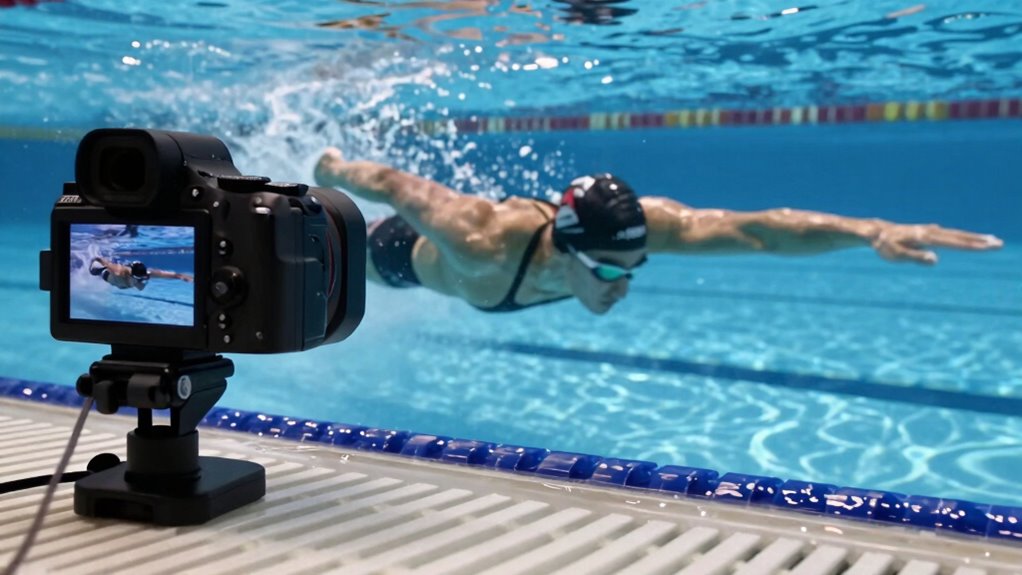
Cameras take this a step further by capturing your swims from multiple angles. With waterproof cameras or underwater mounts, you can record your swim and review it later. But some advanced systems even offer real-time analysis, where you get live feedback as you swim. This instant insight allows you to correct your technique mid-stroke, which accelerates learning and muscle memory development. Because you can see exactly how your body moves through the water, you start to understand subtle details that might otherwise go unnoticed, like head position or the angle of your arms during each pull. Incorporating visual feedback from these tools enhances your ability to recognize and correct errors more effectively.
Underwater visibility is essential here. Good lighting and clear water enhance your ability to see your reflection or camera footage clearly, making the feedback more accurate and useful. When you can see your form in detail, it becomes easier to identify flaws and work on specific improvements. Plus, with real-time analysis, you don’t have to wait until the end of your session to understand what needs fixing. Instead, you get immediate cues, allowing you to adjust your technique on the spot, which is much more effective for skill acquisition. Additionally, the quality of underwater visibility directly impacts the accuracy of your feedback, making these tools even more valuable. Furthermore, understanding how to optimize your visual perception in the water can significantly enhance the effectiveness of these feedback tools. The importance of proper lighting and water clarity cannot be overstated, as they directly influence the quality of your visual feedback and the precision of your adjustments.
A well-lit environment and clear water not only improve visibility but also help to prevent visual distortion, making your feedback more precise. These tools also boost your confidence. Seeing your progress visually motivates you to refine your technique consistently. As you become more aware of your body position and movements, you develop a better kinesthetic sense of swimming, leading to smoother, more efficient strokes. Over time, the combination of enhanced underwater visibility and real-time analysis accelerates your learning curve. You start to internalize good habits faster because you’re constantly aware of your form and can correct errors right away. In short, swim mirrors and cameras turn passive practice into active, informed training, making your improvements more precise and your efforts more productive.
waterproof swim mirror for goggles
As an affiliate, we earn on qualifying purchases.
As an affiliate, we earn on qualifying purchases.
Frequently Asked Questions
How Do Swim Mirrors Differ From Traditional Video Analysis?
Swim mirrors differ from traditional video analysis by providing real-time visual feedback, allowing you to immediately see your technique accuracy while swimming. Unlike video analysis, which requires recording and reviewing afterward, mirrors give instant insights, helping you adjust your form on the spot. This immediate visual feedback enhances learning, making improvements quicker and more intuitive, and keeps you focused on refining your technique during training sessions.
Are Swim Cameras Suitable for All Swimming Skill Levels?
Are swim cameras suitable for all skill levels? Absolutely, especially since many models are beginner friendly, making it easy for newcomers to learn. Advanced features like slow-motion playback and multiple angles help experienced swimmers refine techniques. Don’t let your skill level hold you back—these cameras adapt to your progress and needs, providing valuable feedback no matter if you’re just starting or competing at a high level.
What Is the Cost Comparison Between Mirrors and Cameras?
Swim mirrors are generally more cost-efficient than cameras, offering lower initial investment and minimal installation expenses. Mirrors cost around $20 to $100, with easy setup, making them ideal for budget-conscious swimmers. Cameras, however, tend to be more expensive, ranging from $150 to over $500, and may require professional installation or additional accessories. If you’re looking for a budget-friendly option, mirrors provide a simple, cost-effective way to improve technique feedback.
How Quickly Can Swimmers See Improvement Using These Tools?
You’ll notice improvement in your swimming technique within just a few sessions, as visual feedback sharpens your awareness. Seeing yourself glide through the water with clearer technique encourages immediate adjustments, fostering technique consistency. With each swim, these tools act like a mirror reflecting your form, making subtle errors obvious. Over time, this continuous feedback helps you develop better habits faster, turning small improvements into steady progress.
Do These Devices Require Special Maintenance or Calibration?
These devices generally don’t need much special maintenance, but you should regularly perform sensor cleaning to keep them functioning accurately. Calibration isn’t usually required often, but it’s a good idea to check device calibration periodically to guarantee precise feedback. Keep the equipment in a dry, cool place, and follow the manufacturer’s instructions for cleaning and calibration to maintain peak performance. This way, you’ll get consistent, reliable feedback during your swim sessions.
Conclusion
Swim mirrors and cameras create clear, constant cues that can profoundly sharpen your strokes. By bridging the gap between perception and practice, they bring brilliant breakthroughs in technique. With consistent use, you’ll see swift, substantial strides in your swimming skills. So, seize the synergy of sight and science, and step into a smoother, stronger stroke. The more you monitor, the more mastery you’ll manifest. Make these marvelous tools your training’s secret sauce for success!
Halloween Picks
halloween
As an affiliate, we earn on qualifying purchases.