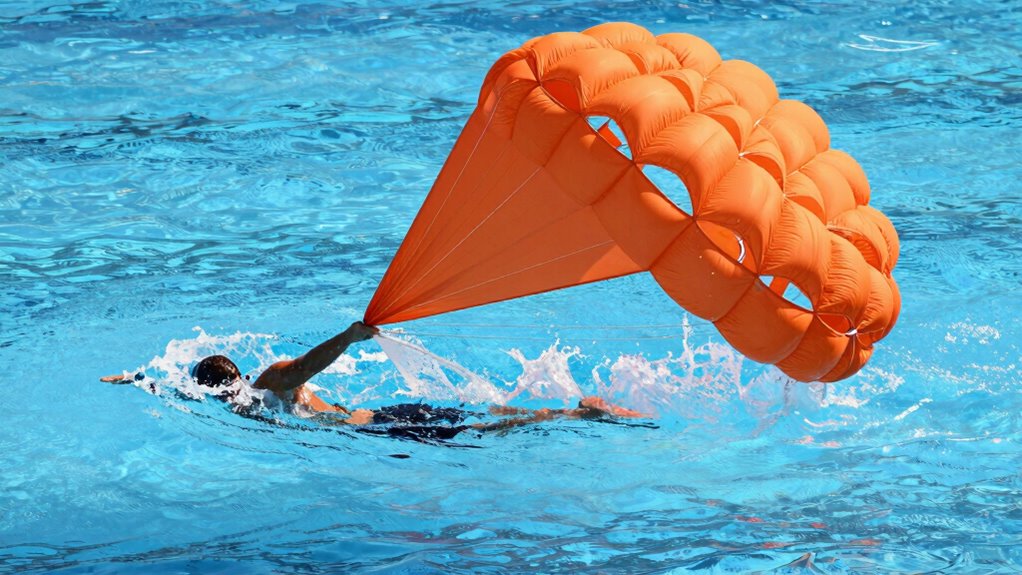

Swim resistance parachutes help you build strength and power by creating drag that forces your muscles to work harder during each stroke. They boost your technique, making you more efficient and helping you maintain a streamlined form, which conserves energy over long distances. Using parachutes also improves your agility, reaction time, and overall control in the water. If you keep exploring, you’ll discover ways to maximize these benefits for better swimming performance.

Get pool and patio gear delivered free with Prime
- Fast, free delivery on millions of items
- Prime Video, Amazon Music and more included
- Member-only deals all year
Key Takeaways
- They primarily develop muscular strength and power by increasing water resistance during swimming.
- They improve technique by encouraging streamlined form and efficient stroke mechanics.
- They enhance agility and quickness in water, promoting better maneuverability and body control.
- They strengthen mind-muscle connection, leading to more deliberate and effective propulsion.
- They support injury prevention and long-term performance through proper body positioning and technique reinforcement.
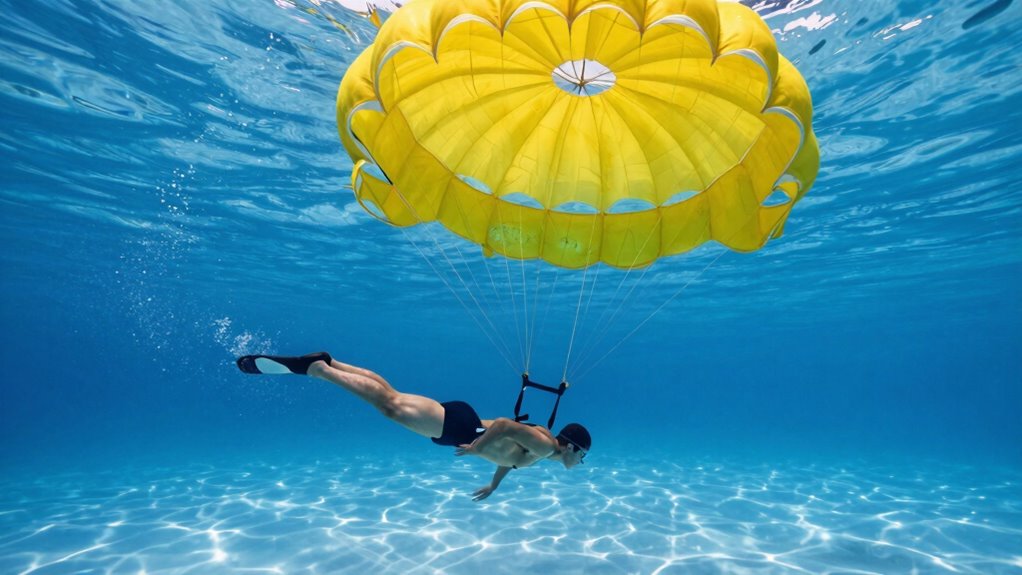
If you’re looking to boost your swimming power and speed, incorporating swim resistance parachutes into your training can be highly effective. These devices create drag as you swim, forcing your muscles to work harder and enhancing your overall performance. But beyond just making you stronger, resistance parachutes are especially valuable for developing aqua agility and improving stroke efficiency. When you use a parachute, you learn to maintain proper body position and streamline your movements, which directly translates into more effective swimming in the water.
Resistance parachutes enhance strength, agility, and stroke efficiency for better swimming performance and technique.
A key aspect of what swim resistance parachutes train is your aqua agility—that is, your ability to maneuver quickly and smoothly through the water. Because the parachute adds resistance, you’re compelled to focus on your technique and body control. As you swim against the drag, you become more aware of your body position, arm movement, and breathing rhythm. Over time, this heightened awareness helps you develop better coordination and quicker reactions, making you more agile in the water. Improved aqua agility means you can change directions more efficiently, handle different strokes with ease, and stay composed during races or intense training sessions.
Additionally, resistance parachutes push your stroke efficiency to new levels. With the added challenge of drag, you’re forced to optimize your technique to minimize unnecessary movements and waste less energy. You learn to engage the right muscle groups at the right time and maintain a more streamlined form. This focus on technique during parachute training transfers directly to your regular swimming, allowing you to glide through the water with less effort and greater speed. As your stroke becomes more efficient, you conserve energy over longer distances, which is essential for endurance and overall performance.
Using resistance parachutes also helps you develop a stronger mind-muscle connection. You become more conscious of how each part of your stroke contributes to forward propulsion. This awareness encourages deliberate, precise movements that maximize output while conserving energy. Over time, this leads to not just increased power but also better control and coordination, further enhancing your aqua agility and stroke efficiency. Incorporating hydraulics into your training can further optimize your resistance and improve your overall swimming mechanics. Additionally, focusing on proper body positioning can prevent injury and ensure you get the most benefit from resistance training.
swim resistance parachute for training
As an affiliate, we earn on qualifying purchases.
As an affiliate, we earn on qualifying purchases.
Frequently Asked Questions
Can Swim Resistance Parachutes Improve Sprinting Speed?
Yes, swim resistance parachutes can improve your sprinting speed. They increase hydrodynamic resistance, forcing you to exert more effort, which enhances your muscle strength and power. This added resistance helps with sprint acceleration by training your body to overcome drag and move faster through water. Regular use of parachutes boosts your overall explosive power and speed, making your sprints more efficient and quicker in competitive swimming.
Are Swim Resistance Parachutes Suitable for Beginner Swimmers?
Yes, swim resistance parachutes can be suitable for beginner swimmers if they stay motivated. The key is choosing a parachute with good durability that withstands frequent use. While the added resistance might seem intense initially, it helps build strength and confidence gradually. As long as you’re motivated and select a durable parachute, it can be a fun, effective way to enhance your swimming skills and stamina.
How Long Should Each Swim Resistance Parachute Session Last?
You should aim for 15 to 30-minute swim resistance parachute sessions, depending on your fitness level. Incorporate it into your training techniques gradually, starting with shorter periods to avoid overexertion. Remember that proper equipment maintenance is key—check the parachute regularly for tears or damage. As you build strength and endurance, you can extend your sessions, but always listen to your body to prevent injury.
Do Swim Resistance Parachutes Help With Endurance Building?
Yes, swim resistance parachutes help build endurance by forcing you to work harder, which improves your overall stamina. They also promote technique refinement because you learn to maintain proper form under increased resistance. Plus, using parachutes can aid injury prevention by strengthening muscles gradually, reducing strain, and encouraging controlled movements. Consistent training with parachutes increases your endurance over time, making you a stronger, more efficient swimmer.
Are There Safety Concerns Using Swim Resistance Parachutes?
Using swim resistance parachutes is like adding a strong wind to your race, but safety concerns are real. You need to prioritize water safety and guarantee proper equipment maintenance to prevent accidents. Always check the parachute for tears, secure it properly, and swim in safe environments. Ignoring these precautions can cause injury or equipment failure, turning your training into a risky endeavor. Stay vigilant to keep your workout both effective and safe.
Conclusion
So, next time you strap on that swim resistance parachute, remember you’re not just adding flair to your workout—you’re secretly harnessing the power of a 19th-century windmill. Sure, it might make you look like a superhero in training, but really, you’re just pretending to battle the elements. Keep at it, and maybe one day you’ll swim so fast, even your swimsuit will be jealous. Resistance training: because who needs easy when you can have epic?
Fall Picks
fall essentials
As an affiliate, we earn on qualifying purchases.