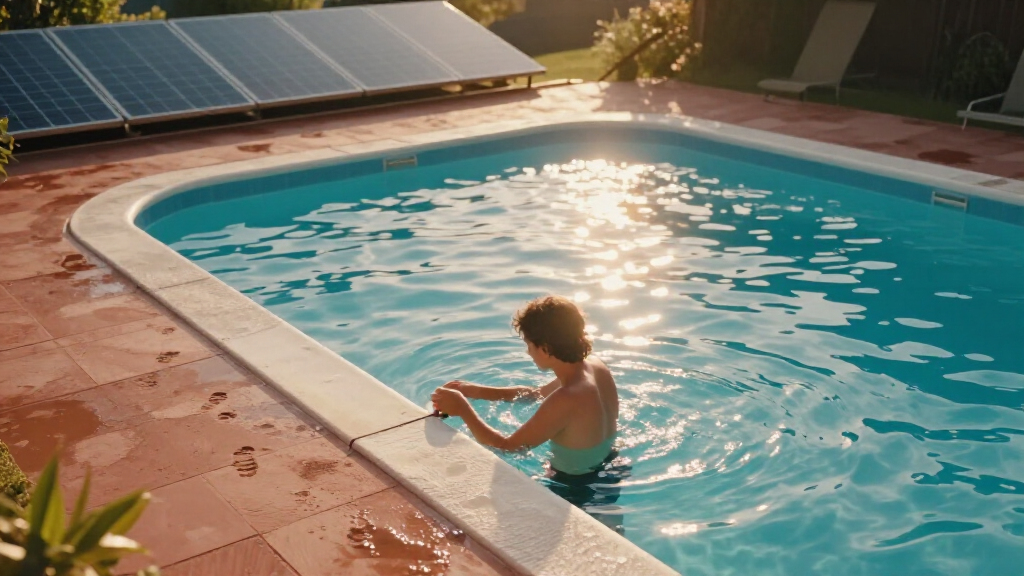
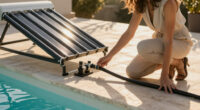
When pool owners compare solar-powered heaters, the real choice is often between a roof-mounted solar heating system and floating solar rings. Both use sunlight, but they do different jobs: a roof system actively sends pool water through collectors to capture heat, while rings mostly help a pool keep heat it has already gained. That difference affects temperature gains, upfront cost, installation and the length of the swimming season.

Get pool and patio gear delivered free with Prime
- Fast, free delivery on millions of items
- Prime Video, Amazon Music and more included
- Member-only deals all year

Intex Solar Pool Water Heater Mat for Above-Ground Pools
- ✔ Heating surface: 11 square feet
- ✔ Temperature increase: Approximately 5 to 9 degrees, depending on weather
- ✔ Pool compatibility: Above-ground pools up to 8,000 gallons

GoFloats V2 Inflatable Solar Pool Heaters, 3-Pack
- ✔ Quantity: 3 inflatable heaters
- ✔ Dimensions: 5 ft x 5 ft each
- ✔ Coverage per heater: 25 square feet

VINGLI Solar Pool Heater for Above-Ground Pools
- ✔ Power source: Solar
- ✔ Design: Domed coil
- ✔ Compatibility: Above-ground pools
A roof-mounted system is the stronger fit for owners who want a warmer pool and expect to use it regularly. Floating rings suit owners who want a low-cost way to slow overnight heat loss, especially in a sunny climate or alongside another heater. The main tradeoff is straightforward: pay more and install a system for substantially greater heating potential, or spend less for a smaller, less predictable boost.
At a Glance
| Criteria | Roof-mounted solar pool heating system | Floating solar pool rings | Winner |
|---|---|---|---|
| How heat is added | Pool water circulates through solar collectors, usually mounted on a roof or rack. | Floating rings absorb sunlight and can reduce evaporation and heat loss; they do not circulate water through collectors. | A |
| Potential temperature gain | Can provide meaningful warming when collector area, sun and pool conditions are suitable; results vary. | Usually modest and dependent on sun, ring coverage, pool size and wind; do not expect rapid heating. | A |
| Upfront cost | Higher; collectors, plumbing, controls and installation add to the purchase cost. | Low; rings can be added gradually without a plumbing project. | B |
| Installation and space | Requires suitable collector space, plumbing connections and often professional installation. | Simple to deploy and remove; uses pool surface area and must be moved for swimming or cleaning. | B |
| Weather dependence | Works best with strong sun; output falls on cloudy days and in cool conditions. | Relies on sunlight and offers limited help through cool, cloudy or windy periods. | Depends |
| Maintenance and durability | Needs seasonal checks of collectors, valves and plumbing; a well-installed system can serve for years. | Requires rinsing, storage and replacement if materials wear, tear or degrade in sunlight. | A |
| Best use | Regular heating of an outdoor pool during sunny parts of the season. | Low-cost supplemental warmth and reduced heat loss for pools that already get enough sun. | Depends |
Intex Solar Pool Water Heater Mat for Above-Ground Pools
The Intex Solar Pool Water Heater Mat is our best overall choice because it pairs a defined pool-size range with clear pump limits and common hose adaptors. Water circulates through an 11-square-foot UV-stabilized PVC mat, which the product says can raise temperature by approximately 5 to 9 degrees depending on weather. That estimate gives buyers a useful reference, but it is conditional: actual warming will depend on sun and operating conditions.Compared with VINGLI’s domed coil, Intex spreads the solar-heated flow across a flat mat and folds away for seasonal storage. Its included bypass valve and adaptors also help clarify how it fits into a compatible pump-and-hose setup. The tradeoff is that buyers need to check the pump carefully: the stated compatibility is up to 1/3 HP or less than 2,000 GPH, and the mat is designed for above-ground pools up to 8,000 gallons. GoFloats avoids that pump connection, but its three panels cover the water surface instead and may demand more area to reach the recommended pool coverage.This is a sensible starting point for owners whose existing equipment falls within the stated limits and who want a compact, circulation-based solar addition. We would skip it for larger pools, incompatible pumps, or situations where dependable heating through variable weather is essential.
Pros:
- Designed for above-ground pools up to 8,000 gallons
- Includes a bypass valve and adaptors for 1.5-inch hose
- Folds for compact winter storage
- Provides a stated temperature increase estimate tied to weather conditions
Cons:
- Performance depends on available sunlight and weather
- Pump compatibility is limited to up to 1/3 HP or below 2,000 GPH
- The 11-square-foot mat is a modest heating surface
Best for: Owners of above-ground pools up to 8,000 gallons with a compatible filter pump who want a foldable, hose-connected solar mat.
Not ideal for: Buyers with pumps above the stated limits, larger pools, or a need for predictable heating regardless of sunlight.
Bottom line: For compatible above-ground pool systems, Intex offers the most clearly specified balance of solar warming, connection hardware, and seasonal storage.
“For compatible above-ground pool systems, Intex offers the most clearly specified balance of solar warming, connection hardware, and seasonal storage.”
GoFloats V2 Inflatable Solar Pool Heaters, 3-Pack
GoFloats V2 takes a different route from the two hose-connected choices: its inflatable panels lie on the pool surface, warming during the day and helping insulate the water at night. The flat shape is designed to minimize overlap, and each panel covers 25 square feet. That makes this three-pack most compelling when a buyer can use its 75 square feet of combined coverage strategically on a suitably sized pool.The coverage recommendation is the deciding factor. The manufacturer advises covering at least 80% of the pool surface for best results, so this set is not automatically enough for every pool. Buyers should measure the water surface first; larger pools may need additional heaters. Intex and VINGLI instead route water through a heated component, which ties them to pump compatibility and hose installation but avoids covering the water with multiple inflatable panels.GoFloats may also complement gas or electric heating, according to the product information. Its ability to help retain warmth overnight is a useful distinction from the other two picks, but we should not read that as a guarantee of a particular temperature gain. We would choose it when surface coverage and insulation are priorities and the pool dimensions make the panel count practical. Those who want a compact component attached to circulation equipment should look to Intex or VINGLI instead.
Pros:
- Three panels provide 75 square feet of combined coverage
- Designed to warm the pool during the day and help insulate it at night
- Flat layout is intended to minimize overlap
- Can complement gas or electric heaters
Cons:
- Best results call for coverage of at least 80% of the pool surface
- Larger pools may require multiple packs or additional heaters
- Supplied details do not state a specific temperature increase
Best for: Pool owners who want a surface-based solar option that can also help insulate water overnight, and whose pool dimensions suit the panel coverage.
Not ideal for: Owners of larger pools unwilling to buy enough panels to approach the recommended 80% surface coverage, or buyers who prefer a hose-connected heater.
Bottom line: GoFloats is the distinct choice for surface coverage and overnight insulation when its three-panel area fits the pool.
“GoFloats is the distinct choice for surface coverage and overnight insulation when its three-panel area fits the pool.”
VINGLI Solar Pool Heater for Above-Ground Pools
The VINGLI Solar Pool Heater is our compact pick for buyers who want to position a solar collector toward the sun and potentially add units later. Its domed coil uses two foldable legs for placement and storage, while hose mounts are intended to keep installation simple. Compared with Intex’s flat mat, the coil is more adjustable in orientation; Intex, however, supplies a clearer pool capacity and pump compatibility range.VINGLI’s expandable design is appealing if one collector is not enough for the desired warming. The product guidance says three or more linked heaters may be needed for faster or longer-lasting results, so we see the included unit as a flexible starting point rather than a guaranteed complete solution. This is the main reason it ranks behind Intex: buyers get fewer concrete sizing details, and may need additional connected units. GoFloats also scales by adding coverage, but it covers the water surface rather than linking coils into circulation.There are a few setup details to account for: recommended pump pressure is below 0.8, air pressure is 35 PSI, and the protective cover should be removed for faster water heating. That cover instruction and pressure guidance matter before installation, especially for buyers who expect a fully specified plug-in replacement for their current pool equipment. VINGLI makes the most sense when compact storage and sun positioning matter more than a defined single-unit capacity. Buyers seeking a stated pool-volume match should favor Intex.
Pros:
- Domed coil design with two foldable legs for sun positioning
- Compact form is designed for easy storage
- Hose mounts support a simple installation approach
- Can be connected with additional heaters and includes a one-year warranty
Cons:
- Three or more linked heaters may be needed for faster or longer-lasting warming
- Provided details do not specify pool capacity or a temperature increase
- Protective cover should be removed to heat water quickly
Best for: Above-ground pool owners seeking a compact hose-connected coil that can be angled toward sunlight and expanded with additional heaters.
Not ideal for: Buyers who need a clearly stated pool-volume capacity or want substantial warming from one unit without expansion.
Bottom line: VINGLI suits buyers who value adjustable positioning and expandable coil capacity, provided they are comfortable with less specific sizing guidance.
“VINGLI suits buyers who value adjustable positioning and expandable coil capacity, provided they are comfortable with less specific sizing guidance.”
As an Amazon Associate we earn from qualifying purchases.
Key Differences
The biggest distinction is active heating versus heat retention. A roof-mounted system uses a pump to move pool water through solar collectors, where it warms before returning to the pool. Its output depends on collector size, sun exposure, pool volume, plumbing and local conditions, but it can deliver a meaningful temperature increase when those factors line up. Floating rings have a smaller role: they take in sunlight and can reduce some heat loss from the water surface, but they lack the collector area and circulation that make a dedicated system a stronger heater.
That performance gap comes with a difference in commitment. A roof system costs more and needs a suitable mounting area and plumbing, but it is the more credible choice if warmer water is a central goal. Rings cost much less and are easy to try, though their effect is limited and they can be awkward to move during regular pool use. Neither option supplies steady heat after sunset or in poor weather; owners who need a reliably warm pool may need a cover, a conventional heater or a hybrid setup.
Detailed Comparison
How heat is added (Roof-mounted solar pool heating system wins — major)
A wins by a wide margin because it circulates pool water through dedicated solar collectors. The pump and plumbing let the system transfer captured solar energy into the pool. B absorbs sunlight at the water surface and can help limit heat loss, but it does not provide the same active, controlled heating. This is a major difference: choose A when heating is the goal, and treat B as a supplement.
Potential temperature gain (Roof-mounted solar pool heating system wins — major)
A is more likely to raise pool temperature enough for owners to notice a meaningful change, provided the collector area and sun exposure suit the pool. No fixed gain is guaranteed: pool size, wind, shade, water flow and starting temperature all matter. B’s contribution is generally modest and can be difficult to distinguish from ordinary sunny weather. The gap is major for anyone trying to extend the swimming season.
Upfront cost (Floating solar pool rings wins — major)
B is the clear winner on purchase price. Rings avoid the collectors, valves, added plumbing and labor that drive the cost of A. That low entry cost makes B a sensible experiment or a small addition to an already warm pool. But low cost does not make it equivalent heating: owners seeking a substantial temperature increase may spend less overall by choosing a system suited to that goal instead of buying rings that cannot deliver it.
Installation and space (Floating solar pool rings wins — moderate)
B is easier to set up: place the rings on the pool and remove them when needed. A needs a sunny roof or rack, plumbing to and from the pool, and compatible circulation equipment; installation may require a professional. B also occupies the water surface, so swimming, skimming and other pool tasks can mean moving it aside. The gap is moderate: rings win for convenience, while A is manageable for owners with a suitable site and willingness to install.
Weather dependence (moderate difference)
Neither option creates heat without useful sunlight, so there is no universal winner. A usually makes better use of favorable sunny conditions because its collectors and circulation are designed to transfer heat into the pool. B’s surface-level contribution is smaller, and neither option can promise warm water through prolonged clouds, cool nights or strong wind. In practice, a pool cover can matter alongside either choice because reducing overnight heat loss helps preserve solar gains.
Maintenance and durability (Roof-mounted solar pool heating system wins — minor)
A has more equipment to inspect, including collectors, plumbing and controls, but a properly installed system can remain in service for years with periodic checks. B has no plumbing to service, yet the rings need handling, cleaning and storage, and sun exposure can wear their materials. The difference is minor for owners who accept either routine: A has more involved maintenance, while B is simpler day to day but may need individual pieces replaced.
Best use (major difference)
The winner depends on what the pool needs. A is the better primary heater for regular use in a sunny location, especially when the owner has room for collectors and plans to keep the system for several seasons. B makes more sense when the pool already reaches a comfortable temperature and the aim is to reduce heat loss or add a modest boost at low cost. For reliable heating regardless of sun, neither is a complete answer on its own.
Roof-mounted solar pool heating system: Pros and Cons
Pros:
- Greater heating potential than floating rings.
- Uses pool circulation to transfer solar heat into the water.
- Can support regular pool use in sunny conditions.
- A permanent installation can serve across multiple seasons.
Cons:
- Higher purchase and installation cost.
- Needs suitable sunny space and compatible plumbing.
- Heating output drops when sunlight is weak.
- Installation and seasonal checks take more planning.
Floating solar pool rings: Pros and Cons
Pros:
- Low upfront cost and simple setup.
- No plumbing changes or roof installation.
- Can help reduce some heat loss from the water surface.
- Easy to add gradually or remove.
Cons:
- Much lower heating potential than a dedicated collector system.
- Must be moved for swimming and some pool maintenance.
- Performance varies with sunlight, pool conditions and ring coverage.
- Materials can wear and may need replacement.
Who Should Choose What
Choose Roof-mounted solar pool heating system if:
- You want a noticeable temperature increase for regular outdoor pool use.
- Your property has an unshaded roof or rack area suitable for collectors.
- You plan to keep the pool and heating setup for several seasons.
- You can accept higher upfront cost and installation work in exchange for greater heating capacity.
Choose Floating solar pool rings if:
- Your pool is already close to comfortable and you want a low-cost supplement.
- You want to try solar assistance without plumbing work or a permanent installation.
- You can move the rings aside when swimming and maintain them as needed.
- You value low initial spending more than a substantial or predictable temperature gain.
Skip both if: You need dependable warmth through cloudy weather, cool nights or a long season; compare a conventional heater or a hybrid system, and pair heating with a suitable pool cover.
Value for Money
Rings cost less, but their value is strongest when expectations stay modest: they may help a sunny pool retain warmth and provide a low-cost trial, but they are not a cheaper substitute for a dedicated heater. Paying more for A is worth it for owners who will use the pool often, have a viable collector location and need a more substantial temperature increase over multiple seasons. If the pool is used only occasionally or is already warm enough, the additional installation cost may not pay off. Compare the full installed price of A with the heating season you expect to gain, and factor in the cost of a cover if overnight losses are a problem.
Final Verdict
Choose the roof-mounted solar pool heating system if your main goal is warmer water and a longer sunny-season swimming window. It costs more and takes planning, but it offers the stronger heating potential because it circulates water through dedicated collectors. Choose floating rings if you mainly want an inexpensive supplement or a way to help retain heat in a pool that already gets warm enough. The deciding factor is whether you need active heating: if you do, A is the clear choice; if you only want low-cost assistance, B is the better fit. If warmth must be dependable in poor weather, skip both as sole heaters and compare a conventional or hybrid option.
Frequently Asked Questions
Do floating solar rings heat a pool as well as roof-mounted solar collectors?
No. Roof-mounted collectors circulate pool water through a larger dedicated heating area, so they generally have much greater heating potential. Rings can absorb sunlight and reduce some surface heat loss, but should be treated as a supplement.
Are solar pool rings worth buying?
They can be worthwhile when a pool is already fairly warm and you want an inexpensive addition with modest expectations. They are poor value if you are buying them to replace a heater that needs to raise pool temperature substantially.
Can a roof-mounted solar pool heater work on cloudy days?
It can still circulate water, but useful heat output falls when sunlight is weak. Neither roof collectors nor rings can promise a steady temperature through extended cloudy or cool conditions.
Should I use a pool cover with a solar heater?
A cover can help either setup by reducing heat lost from the water, especially overnight. It does not replace a heater, but retaining more of the heat gained during sunny hours can improve the practical result.
Which option is better value over several seasons?
A roof-mounted system can be better value if you need meaningful heating and will use it regularly for years. Rings have the lower initial cost and suit pools that need only a small boost. The right comparison is the installed cost of A against the limited heating contribution and replacement needs of B.