
TL;DR

Get pool and patio gear delivered free with Prime
- Fast, free delivery on millions of items
- Prime Video, Amazon Music and more included
- Member-only deals all year
Solar-powered pool heaters circulate pool water through sun-warmed collectors, then return it to the pool. Their performance depends on sunlight, collector area, climate, pool size, and heat loss; a pool cover can help retain warmth, especially overnight. Compare site-specific installation quotes and expected use before choosing a system.
Solar thermal collectors heat pool water directly; photovoltaic panels generate electricity for a separate device.
Sun exposure, collector area, climate, pool size, target temperature, wind, and use patterns shape heating results.
A pool cover helps retain warmth and reduce evaporation, but it does not replace active heating collectors.
Ask installers to state their temperature, season, weather, and pool-cover assumptions in the quote.
Check pump compatibility, maintenance needs, and freeze protection for your location before choosing a system.
How solar-powered pool heaters move heat into your pool
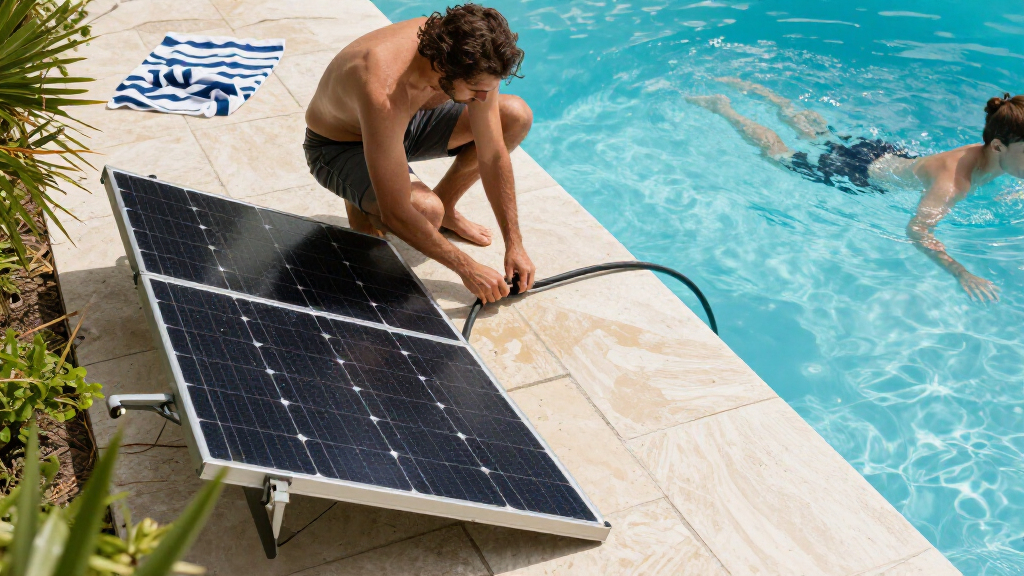
Solar-powered pool heaters warm pool water by sending it through collectors exposed to sunlight, then returning the heated water to the pool. A typical setup connects the **pool pump**, **filter**, **solar collectors**, and **controls**; some systems use a separate solar pump. The phrase “usually by circulating” describes the basic process: water moves through the collectors when their temperature makes that route useful. Say you have an outdoor pool and collectors on a sunny roof. The pump sends filtered water up to the collectors, sunlight warms it, and the water flows back into the pool. If the collectors are cooler than the pool, controls can divert the water so the system does not send cooler water back. A solar thermal collector differs from a **photovoltaic panel**. The collector heats water directly; a photovoltaic panel produces electricity, which can power a heat pump or other heater. Both use the sun, but they do different jobs.Which collector type fits your pool and climate?
Unglazed collectors often suit outdoor pools in warm or mild climates, while glazed collectors can capture heat more effectively in cooler conditions and generally cost more. A pool cover serves a different purpose: it helps retain heat and reduce evaporation but does not actively heat water like collectors do. | Option | How it works | Often suits | Tradeoff | |—|—|—|—| | Unglazed collector | Pool water passes through plastic or rubber collectors | Outdoor pools in warm or mild climates | Output depends heavily on sun and weather | | Glazed collector | Insulated panels or tubes collect heat | Cooler conditions or colder-season heating needs | Typically costs more | | Solar pool cover | Covers the water to limit heat loss and evaporation | Pools that need better heat retention | Does not actively add heat | For example, an owner with a sunny pool in a mild region might choose unglazed collectors and cover the pool each night. A household that wants to swim during colder weather may need glazed collectors or another heater alongside solar, depending on the site and temperature target. Treat any promised temperature or efficiency figure as a product-specific claim to check against your pool and local conditions.What determines how warm your pool gets?
Solar pool heaters perform best when collectors get good sun, their area suits the pool and target temperature, and the pool holds onto the heat they add. **Climate**, **wind**, pool size, pool use, and system flow also affect the result, so no single temperature estimate fits every backyard. Consider two similar pools on the same street. One has collectors in full sun and a cover the owner uses overnight; the other sits under tree shade and stays uncovered on windy evenings. Even with similar equipment, the first pool has conditions that favor more useful warmth. The **pool cover** matters because heating the water is only half the job. Limiting heat loss overnight or in windy weather helps retain warmth already in the pool, and can also reduce water evaporation. More collector area can deliver more heat, but the design still needs to match the site and system.What to ask before you get an installation quote
A useful quote explains its assumptions about pool use, cover use, local weather, and your target temperature. Before comparing prices, ask an installer to show how the proposed collector area, mounting location, plumbing, controls, and pump fit your pool.- Describe how you use the pool. Tell the installer which months you swim and whether you heat the pool continuously or at certain times.
- Review the site. Ask how roof orientation, shade, roof condition, or available ground space affect collector placement.
- Confirm pump compatibility. Ask whether your existing pump can handle the plumbing and flow needs, or whether the design uses a separate solar pump.
- Set expectations. Ask what temperature range and season the estimate supports, and what weather and cover use it assumes.
- Check upkeep and winter care. Ask how to inspect the collectors, valves, controls, and mounting hardware, and what freeze protection or seasonal draining your location requires.
Where solar heating shines—and where it needs help
Solar pool heating is most practical for an outdoor pool with good sun exposure, a suitable installation site, and a heating goal that fits local weather. It can extend the swimming season and reduce reliance on gas or electric resistance heating, while the pump and controls still use electricity. Solar heating has limits during cloudy or cold periods, at night, and in cool, windy conditions that increase heat loss. A larger collector area and a cover may help, but a colder climate or a high temperature target may call for a backup heater. Indoor pools also need a different overall design because heating needs and humidity control change the equation. Picture a family trying to keep a pool comfortable through a cool, overcast stretch. Their solar collectors provide less heat when sunlight falls; a cover can retain warmth the pool already has, while a heat pump or conventional heater can offer added flexibility. Pairing solar thermal collectors with photovoltaic panels or a heat pump is possible, but adds equipment and cost. Solar pool heating is mature technology, so look for a system sized for your needs rather than a claim of a recent breakthrough.What upkeep should you plan for?
Solar pool heaters usually need periodic checks of the collectors, plumbing, valves, controls, and mounting hardware, plus winter care where freezing temperatures occur. Maintenance is often limited, but **water chemistry**, materials, climate, installation quality, and care all affect how long equipment lasts. As a practical example, before winter an owner in a freezing region should follow the system maker’s instructions for seasonal draining or freeze protection. A mild-climate owner may not need that same seasonal step, but can still inspect the system and keep the pool filtration equipment in good condition. Ask the installer which maintenance tasks you can handle and which need a professional. For current product availability, efficiency claims, incentives, and installation prices, check local sources and get current quotes; those details change by region and over time.Frequently Asked Questions
How warm will a solar-heated pool get?
There’s no single temperature to expect. **Sunlight**, collector size, local weather, pool heat loss, and cover use all shape the result. Ask an installer for a site-specific estimate that explains its assumptions.Can solar pool heating work on cloudy days or at night?
Collectors produce less useful heat when sunlight is limited, and they generally do not heat the pool at night. A **pool cover** can help retain warmth that is already in the water.Can I connect a solar pool heater to my existing pump?
Often, yes, but the plumbing, valves, controls, and added flow resistance need to suit your pump. Ask the installer to confirm compatibility with your **existing pool equipment**.Does a solar pool heater work in winter?
It may add some heat on sunny winter days, but short days, cold air, and greater heat loss can limit performance. Your system may also need **freeze protection** or seasonal draining, depending on its design and location.Is solar pool heating worth the cost?
It can be attractive when your pool gets strong sun, you use it often, and conventional heating costs are high. Compare **local installation quotes** and likely savings for your site, and ask how a cover affects the estimate.Conclusion
Choose solar pool heating when your site gets good sun and your heating goal matches local conditions. Ask for a quote built around your pool, your swim season, and whether you’ll use a cover; the right system starts with those details, like sunlight landing on the water at the end of a long day.Halloween Picks
halloween
As an affiliate, we earn on qualifying purchases.